
Home » Cashless Payments Knowledge Hub » Best Time to Send Money Abroad From UAE: Weekday vs. Weekend Explained

Sending money is often routine. You choose an amount, complete the transfer, and expect the outcome to match what you had in mind. But in the world of global finance, expectations do not always align with reality. Even when flat fees remain unchanged, the total amount received by your family or business partner can vary significantly from one day to the next. For residents looking for the cheapest time to transfer money internationally, understanding this dynamic is crucial.
One of the less obvious, yet most impactful, reasons for this variation is timing. Whether you want to know the best time to send money from UAE to India, the Philippines, or Europe, the day you choose to initiate a transaction, specifically whether it falls during the active trading week or over a quiet weekend can heavily influence the exchange rate applied to your money, ultimately dictating the final value delivered.
When consumers compare transfer options, the focus is almost always on the upfront transaction fees. However, the exchange rate applied at the exact moment of transfer is arguably more important in determining the final outcome.
Exchange rates are not static; they are living figures that respond to global trading activity, shifting economic signals, and volatile market sentiment. This constant movement means that even if you send the exact same Dirham amount twice in one week, the conversion result will likely differ. Understanding this volatility is the first step toward making smarter remittance choices.
The key to understanding price fluctuations lies in the mechanics of the global foreign exchange (forex) market. This market operates as a decentralised network across major financial centres like London, New York, and Tokyo. Because these centres span different time zones, trading continues virtually uninterrupted from Monday morning in Asia to Friday afternoon in New York.
This 24/5 activity allows exchange rates to update in real-time based on the immediate laws of supply and demand. However, this flow pauses when the sun sets on Friday in the United States. During the weekend, live trading effectively halts. While digital platforms allow you to start a transfer on a Saturday, the “live” pricing environment that drives the tightest rates is no longer active. This creates a gap between your transaction time and the availability of market-driven rates.
When the global markets are closed, exchange rates are no longer being “discovered” through active trading. However, the world doesn’t stop turning. Economic updates, geopolitical shifts, and sudden movements in commodity prices (like oil) continue to happen while the forex markets are asleep.
To protect themselves against the “opening shock” of the market on Monday morning, many providers adjust their weekend rates. Essentially, the rate you get on a Sunday might include a “safety buffer” for the bank, which can make it less favourable than a mid-week rate.
For example, if you send 1,000 AED and the exchange rate differs by even 1–2%, your recipient could receive the equivalent of 10–20 AED less on a weekend transfer. While this may seem minor once, repeated monthly transfers can lead to a meaningful loss over time.
For the most competitive rates, avoid initiating large transfers late on Friday (UAE time) or over the weekend. Because global financial markets are closed, many remittance providers apply protective risk markups or simply delay transaction execution until Monday morning.
Instead, it is highly recommended to send money between Monday and Thursday, as mid-week trading typically offers higher liquidity and tighter spreads. (Suggested read: 6 Tips to Save Your Money on Foreign Exchanges)
Exchange rate margins shrink when global trading volume is at its highest. The ideal overlap window occurs when the UAE workday aligns with active trading sessions in both Asian and European hubs (specifically London).
Therefore, the best time of day to transfer money is generally between late morning and early evening (UAE time), ensuring peak liquidity for major currency corridors.
The remittance market experiences a surge in demand at the end of the month and immediately after the typical UAE payday.
This rush can occasionally coincide with less favourable exchange rates or network congestion. Opting to schedule your transfers for the middle of the month often provides better overall value and smoother processing. (Learn more: Remit Like a Pro: Avoid These 5 Common Mistakes)
Currency demand predictably spikes around major cultural festivals, global holidays, and peak international tuition deadlines. Initiating your transfers one to two weeks prior to these high-demand events can help you bypass seasonal exchange rate fluctuations and potential fee spikes.
Timing Factor | Best Practice | Why it Matters |
Day of Week | Monday – Thursday | Avoids “Weekend Spread” buffers. |
Time of Day | 11 AM – 8 PM (GST) | Overlaps with peak London liquidity. |
Time of Month | 10th – 20th | Bypasses the payday volume surge. |
In finance, “liquidity” refers to how easily a currency can be bought or sold without causing a major price change. During the peak working week, liquidity is high because millions of people are trading. This high volume keeps the “spread”, the difference between the buy and sell price, very narrow.
When trading activity drops over the weekend, liquidity dries up. In these low-liquidity environments, spreads typically widen. For the average person sending money from the UAE, this isn’t shown as a “weekend fee,” but it is hidden within a slightly weaker exchange rate. Over months of regular transfers, these small spread variations can add up to a significant amount of lost value.
The UAE is one of the most active remittance hubs in the world. For the vast majority of the population, sending money home isn’t a one-off event; it’s a monthly necessity.
Because these transfers are repetitive, the “timing trap” becomes even more relevant. A difference of just a few pips in an exchange rate might seem negligible on a single 1,000 AED transfer. However, when multiplied across twelve months and several years, the cumulative difference could fund an entire extra transfer. In the UAE, timing is a practical financial strategy, not just a technical detail.(Read More: Understanding Exchange Rates and Fees: The Cheapest Way to Send Your Money Home)
The World Bank has noted that exchange rate margins (the “hidden” part of the rate) actually make up a massive portion of global remittance costs. Without clear visibility into these rates, it’s impossible to know if you’re getting a fair deal.
Transparency is the antidote to high costs. When a platform clearly displays both the fee and the rate upfront, you can make an informed comparison. Being able to see that a Tuesday rate is better than a Saturday rate allows you to optimise your savings without needing to be a forex expert.
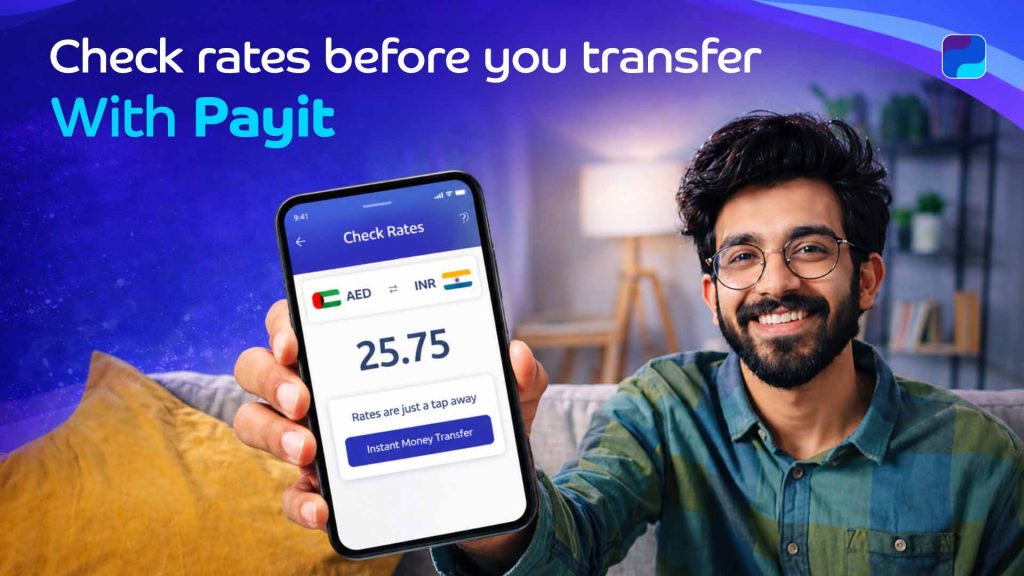
Digital financial services have removed the physical barriers to international transfers. You are no longer tethered to a brick-and-mortar exchange house’s opening hours.
With Payit, powered by First Abu Dhabi Bank, the power is in your pocket. You can manage the entire lifecycle of a transfer from your mobile device. Because you can review the transaction details and the specific exchange rate before hitting “confirm,” you are empowered to act on the timing insights mentioned above. You can choose to send immediately during a market peak or wait for a more favourable moment. (Learn more: International Money Transfer Services with Payit)
While you cannot control the global economy, you can control your calendar. If a transfer is not an emergency, aim to initiate it during peak market hours, typically between Monday and Thursday. This ensures your transaction aligns with live trading conditions when spreads are thinnest.
By moving away from a fixed routine and instead aligning your transfers with active market cycles and high liquidity periods, you ensure that more of your money reaches its destination. (Suggested Guide: The Ins and Outs of International Money Transfer in UAE)
Ultimately, maximising the value of your remittance comes down to having the right visibility and the right tools, like Payit, to act when market conditions are most in your favour.
Time of day:
Time of month:
Seasonality:
The best days are Monday through Thursday when global financial markets are fully operational.
Aim for the middle of the month (10th–20th) to bypass the high-volume payday rush.
It is best to send money one to two weeks before the holidays begin to avoid seasonal demand spikes and potential processing delays.
Yes; since global markets are closed on Saturdays and Sundays, providers often apply a protective risk buffer to rates during this time.
The least optimal times are weekends and the immediate days following payday.
Use a digital wallet like Payit to view live rates before confirming your transfer.
[1] Consumer Financial Protection Bureau – Foreign exchange rates and costs
https://www.consumerfinance.gov/ask-cfpb/what-is-a-foreign-exchange-rate-en-101/
[2] Investopedia – Bid-ask spread and liquidity
https://www.investopedia.com/terms/s/spread.asp
[3] UAE Government – Official working week
https://u.ae/en/information-and-services/public-holidays-and-religious-affairs/working-hours [4] UAE Government – Population statistics
https://u.ae/en/information-and-services/public-holidays-and-religious-affairs/population
[5] Payit Official Website
https://payit.ae
[6] World Bank – Remittance pricing and exchange rates
https://www.worldbank.org/en/topic/remittances