
Home » How currency fluctuations affects UAE remittance charges
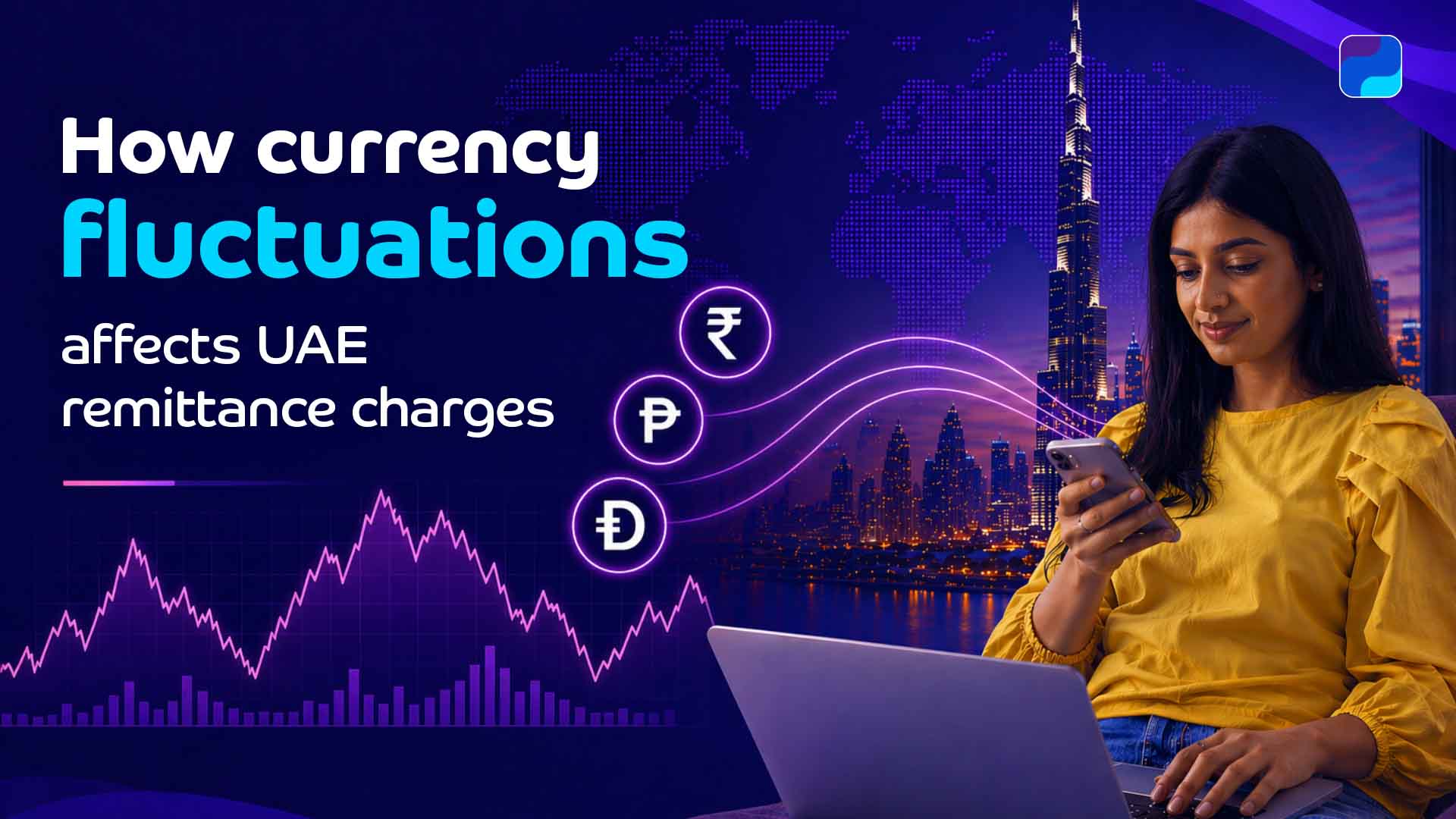
Currency fluctuations can significantly impact how much money your recipient actually receives in UAE remittances, sometimes even more than transfer fees. Exchange rates change daily due to global economic factors, so the same amount sent on different days can convert to different values. Hidden costs like exchange rate margins and timing of transfers also affect the final amount.
To reduce losses, it helps to monitor exchange rates, avoid sending during high volatility, split large transfers if needed, and choose transparent digital platforms that show real-time rates and total payout. Ultimately, being aware of timing and currency movements helps you get better value from every transfer.
Sending money home is often part of a routine. You choose an amount, make the transfer, and expect your recipient to receive exactly what you had in mind. But sometimes, the final amount changes. And it is not always because of fees.
Currency volatility plays a bigger role than most people realise.
Even when transfer charges stay the same, changing exchange rates can quietly affect how much your recipient actually receives. Understanding how this works can help you make better decisions and avoid unexpected shortfalls.
Currency volatility simply refers to how much and how quickly exchange rates change between two currencies.
For example, the value of the UAE dirham against the Indian rupee or the Philippine peso can shift daily. These changes are influenced by several global factors, including:
According to the International Monetary Fund, exchange rates fluctuate based on economic conditions and investor confidence across countries.
For someone sending money, this means the same amount in dirhams may not convert to the same amount in another currency tomorrow. [1]
You may send ê 1,000 today, and your recipient will receive a specific amount. If you send the same ê 1,000 tomorrow, the amount you receive could be lower, even if the transfer fee has not changed.
See a real AED-INR example and instant transfer guide
This happens because the exchange rate has moved.
According to the World Bank, exchange rate fluctuations are among the key factors affecting remittance values globally, sometimes more than transfer fees themselves.
So even if a platform shows low or fixed fees, the real impact often comes from the rate applied at the moment of transfer.
When people think about remittance costs, they usually focus on visible fees. But there’s another hidden factor: exchange rate margins.
The mid-market rate is the real exchange rate you see on Google. But most financial services don’t give you that rate. Instead, they offer a slightly lower rate (their “own rate”), and the difference is their margin.
For example, if the real rate is 1 ê = 25.75 INR, you might actually get 1 ê = 25.25 INR from a provider. That small difference reduces the final amount your recipient receives.
On top of this, exchange rates keep changing every day, so the amount can vary even further. Over time, especially with frequent transfers, these small differences can add up.
Another important factor is liquidity in currency markets. When demand for a particular currency rises suddenly, exchange rates can shift more sharply. This is especially common during global events or regional economic changes. For remittance senders, this means rates can move quickly, making timing and awareness even more important.
Currency markets move constantly. Rates can shift within hours in response to global news, oil prices, or economic updates.
For example, during the COVID-19 market volatility in 2020, the ê –INR exchange rate saw sharp swings as global financial markets reacted to uncertainty. According to the International Monetary Fund (IMF), emerging market currencies experienced heightened volatility during this period due to sudden shifts in global risk sentiment and capital flows. This aligns with FX historical data showing ê moving roughly from around ₹19.5 to over ₹23 for 1 ê at different points in 2020.
This means a transfer of ê 1,000 could have varied from about ₹19,500 to ₹23,000, depending purely on the timing of the transfer, even if the amount sent and fees remained the same.
If inflation rises in a country, its currency may weaken. If interest rates increase, the currency may strengthen. The U.S. Federal Reserve explains that changes in interest rates directly influence currency strength and capital flows.
Sending money when the exchange rate is favourable can mean your recipient receives more without you increasing the amount you send.
Suggested Read: Avoid these 5 remittance pitfalls, including poor timing and hidden fees.
If you send money regularly, currency volatility can have a bigger impact than you think.
Small differences in exchange rates may seem minor at first. But over weeks or months, they can lead to noticeable differences in the total value your recipient receives.
According to international organisations such as the World Bank, exchange rate movements are a key factor affecting remittance outcomes, especially in developing and emerging markets where currencies can fluctuate more frequently.
This makes it even more important to stay aware of trends rather than sending blindly at the same time every month.
The UAE dirham (ê ) is pegged to the US dollar (USD), which means its value is fixed and does not freely move up or down in global currency markets. The Central Bank of the UAE maintains this peg at a stable rate of approximately 1 USD = 3.67 ê .
Because of this system, the ê is considered a stable currency, and it does not experience daily fluctuations like many other global currencies. Instead, the UAE maintains its value by managing reserves and aligning monetary policy closely with the US Federal Reserve’s interest rate decisions.
However, this stability only applies to the ê –USD relationship. When remittances are sent to countries like India or the Philippines, the ê must be converted into local currencies such as INR or PHP, and these currencies do fluctuate freely based on global market conditions.
To see the impact:
For example:
So even though ê itself is stable, the final remittance value is still exposed to global USD-driven currency movements on the receiving side.
In short, the ê –USD peg removes volatility from one side of the equation, but the real fluctuation comes from how the recipient currency reacts to global USD and economic conditions.
While you cannot control currency movements, you can make smarter choices around them.
Modern payment platforms are designed to make international transfers more transparent and convenient.
With Payit, users can use Money Transfer (International Remittance) to send money to over 200 countries directly from the app, removing the need to visit exchange houses.
Through Instant Bank Transfer, users can send money quickly to supported countries, including real-time transfers in select corridors.
With Transparent Digital Wallet Tracking, users can manage transactions, monitor transfers, and handle payments directly within the app, giving better visibility over their money flow.
Payit also enables 24×7 Digital Access, meaning transfers can be initiated anytime without relying on branch hours or physical exchange centres.
This combination of instant access, multiple transfer options, and digital visibility helps users act faster when exchange rates are favourable instead of waiting or delaying transfers.
Suggested Read: Learn the step-by-step process for international transfers via Payit
In a volatile currency environment, clarity is key. Knowing the exact rate being applied, the fees involved, and the final amount your recipient will receive helps you make informed decisions.
The World Bank has consistently highlighted the importance of transparency in reducing remittance costs and improving user trust. When you understand both the visible and hidden factors, you are less likely to be caught off guard.
Explore how digital wallets like Payit beat traditional exchange houses on transparency
Currency volatility is not something to fear, but it is something to be aware of.
A small shift in exchange rates can change outcomes more than expected. But with a little awareness and the right tools, you can stay in control.
Instead of focusing only on fees, start looking at the full picture. Check rates, time your transfers, and use platforms that give you flexibility.
Sending money is not just about the amount you transfer. It is about the value your recipient actually receives.
And in a world where currencies are always moving, sending smarter makes all the difference.
What are the best UAE apps for real-time exchange rate alerts before sending remittances?
Several digital remittance apps in the UAE allow users to view live exchange rates before sending money, helping them decide the right time to transfer based on market conditions. Apps like Payit also provide exchange rate visibility during the transfer journey, making timing decisions easier.
How does UAE’s ê -USD peg affect remittance volatility for Indian or Filipino workers?
The UAE dirham is pegged to the US dollar, which keeps it relatively stable against USD. However, volatility comes from recipient currencies like INR or PHP, which fluctuate daily due to global economic factors, affecting the final remittance value. Platforms like Payit help users act quickly when favourable rates appear through instant transfer capability.
Should I use forward contracts or limit orders to hedge against currency swings in UAE remittances?
Forward contracts and limit orders are generally used for large or institutional transactions. For most individuals, digital wallets like Payit are more practical, as they offer instant transfers and transparent exchange rates at the time of sending, helping users react quickly to market changes.
What UAE Central Bank rules protect remitters from excessive FX markups in 2026?
The UAE Central Bank regulates licensed remittance providers to ensure transparency in fees and exchange rates. Providers must clearly disclose the applicable FX rate and charges before transaction confirmation.
How do oil price shocks influence ê -INR rates for UAE expat remittances?
Oil price movements can indirectly influence Gulf economies, including the UAE, which is a major oil exporter. This can impact market sentiment and short-term currency movement in remittance corridors like ê –INR.
Real Exchange Rates: What Money Can Buy
About Remittance Prices Worldwide | Remittance
FRB: Financial Globalisation and Monetary Policy