
Home » Cashless Payments Knowledge Hub » Is Sending Money Through Exchange Houses Safer Than Banks?
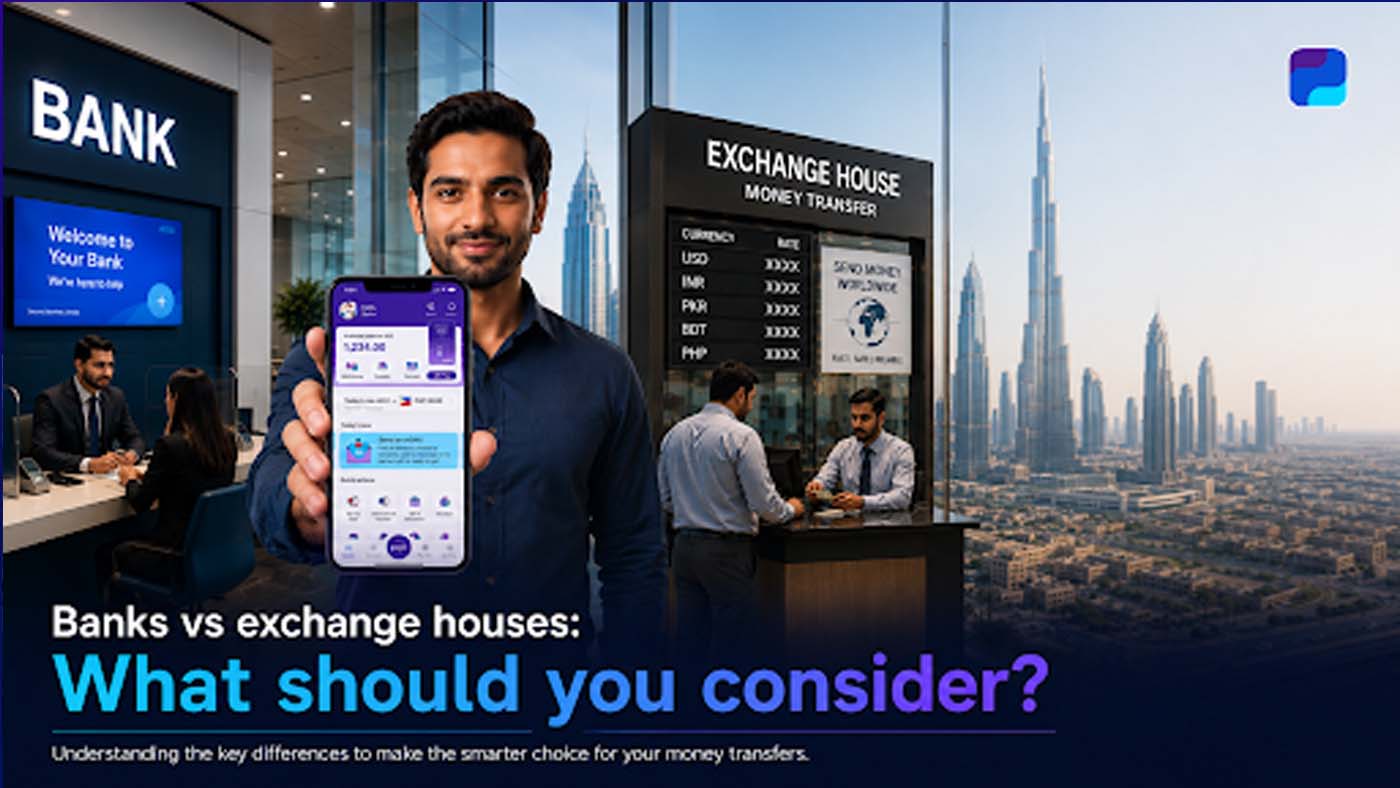
When it comes to sending money home, many people living in the United Arab Emirates want two things above everything else. They want their money to arrive safely and quickly. Most people usually choose between banks and exchange houses. Both options are widely used and considered secure [1]. However, the experience of using them can vary widely depending on your needs.
Let’s have a look at how both work in simple terms and understand which option may suit you better in different situations.
If you send money through a bank, the transfer usually happens from your bank account to the recipient’s bank account. This process is linked to international banking networks and follows strict compliance rules [2].
Exchange houses work differently. They are specialised service providers that focus mainly on remittances. You give them cash or transfer money, and they send it through their network. The recipient can receive it as a cash pickup or a bank deposit, depending on the service [3].
Both systems are legal and regulated in the UAE. Both are designed to keep your money safe under financial supervision [2].
Many people assume banks are safer because they are older and more traditional. Banks do have strong security systems and are regulated by the Central Bank of the UAE [2]. They use encryption, identity verification, and fraud monitoring systems.
However, licensed exchange houses in the United Arab Emirates are also strictly regulated by the same financial authority [2]. They follow anti-money laundering rules and customer verification processes.
This means both banks and exchange houses operate under official supervision, and both are considered safe when licensed [2].
Because of this, safety alone is not usually the deciding factor anymore [1].
Banks are often seen as more trustworthy because people already use them for salary deposits and savings. This familiarity builds confidence.
Exchange houses may feel more transaction-focused, but they are still safe when licensed [2]. Many people use them daily without issues.
In simple terms, both are safe, but banks feel safer due to familiarity.
Bank transfers can take 1 to 3 business days, depending on the destination and the banking network [4].
Exchange houses are often faster. Many transfers can reach within minutes or a few hours, especially for cash pickup services [3].
For urgent needs like medical or family emergencies, exchange houses are often preferred.
Banks usually charge higher transfer fees, and additional intermediary bank charges may apply [4].
Exchange houses often provide more transparent pricing and competitive rates, especially for regular remittances [3].
This is why many people compare the total received amount rather than just fees.
Exchange rates directly affect how much money the recipient gets.
Banks may offer slightly lower exchange rates compared to market averages [4].
Exchange houses often provide more competitive rates because remittance is their core business [3].
Even small differences matter for monthly transfers.
Banks are convenient if you already use them for salary and savings, especially through mobile banking apps [2].
Exchange houses are widely available and designed for quick walk-in transactions. Many also offer apps and online services now [3].
This makes them more flexible for people who send money regularly.
Digital remittance platforms are becoming more popular because they combine speed and convenience in one place.
Apps like Payit allow users to send money directly from their phone without visiting a branch. These platforms operate under regulated financial systems and partner with licensed institutions [5].
For example, instead of visiting a branch, users can complete a transfer in a few minutes with full visibility of fees and exchange rates.
This shift is part of a global trend where digital payments are growing due to convenience and transparency [1].
Banks are better suited for larger or less frequent transfers. They also help if you want all financial services in one place [2].
They are useful when the recipient prefers direct bank deposits and when documentation is important.
Exchange houses are often preferred for regular remittances due to speed and competitive rates [3].
They are especially useful when families prefer cash pickup options.
Digital remittance platforms are becoming an increasingly popular option for international money transfers. Like banks and exchange houses, they operate within regulated financial systems and use security measures such as identity verification and transaction monitoring to help protect users.
They also combine the advantages from both traditional options. Like banks, they support account-based transfers while offering the speed, convenience, and transparency often associated with exchange houses. Payit allow users to send money, track transactions, and review fees and exchange rates directly from their phones [5].
As cross-border payments continue to evolve, digital remittance services are expected to play an increasingly important role in the future of international transfers.
Before sending money, always check if the provider is licensed by the Central Bank of the UAE [2].
Also compare total cost, including fees and exchange rates [4].
Check delivery time and payout options for the recipient.
These checks help avoid confusion and ensure smooth transfers.
Both banks and exchange houses are safe ways to send money from the United Arab Emirates when they are licensed and regulated [2].
The difference is mainly in experience. Banks are structured and stable, while exchange houses are faster and more flexible [3].
With digital platforms like Payit, people now choose based on speed, convenience, and total value rather than tradition alone [5].
CITATIONS
1.About Remittance Prices Worldwide | Remittance
2.CBUAE | Central Bank of the UAE
3.UAE Remittances 2026: Banks, Exchange Houses & Apps
4.Is it cheaper to send money via banks, online, mobile applications or exchange houses?