
Home » Cashless Payments Knowledge Hub » UAE Bank Holidays 2026: Which Ones Delay Money Transfers
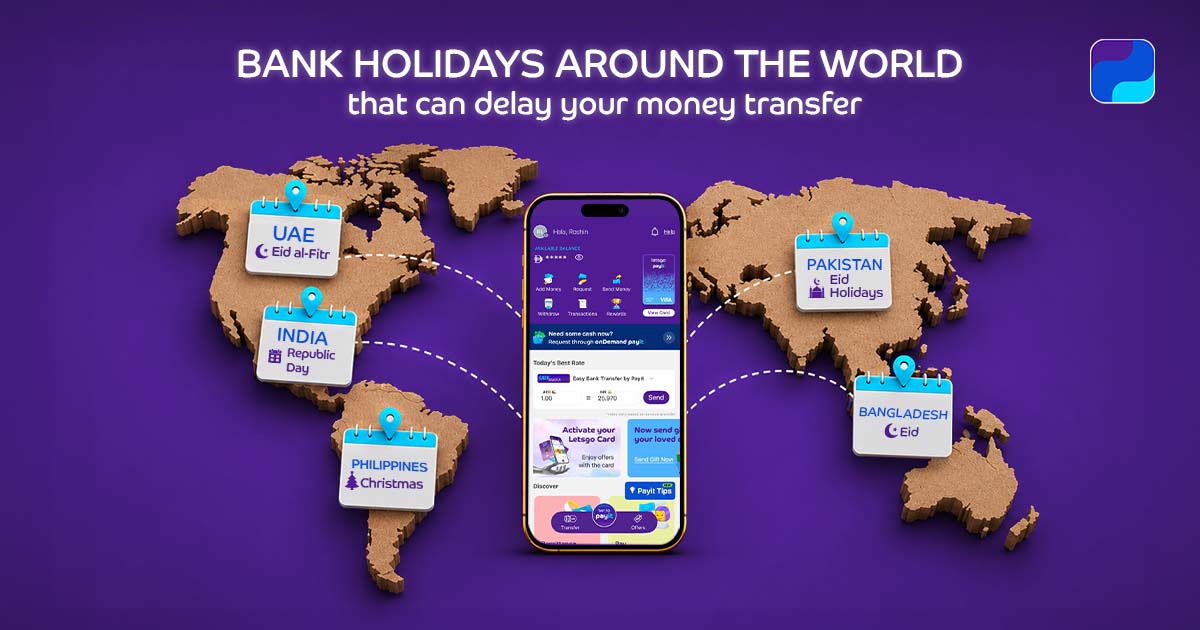
Who doesn’t love a public holiday? It’s when people back home gather to celebrate Eid, Diwali, or Christmas, or simply to spend time with family. For expats in the UAE, it is also the time to send money for the festivities. You hit send on your phone expecting instant delivery, but a day or two passes and your family is still waiting. Why? Because when local banks abroad close for a holiday, your money transfer pauses [1].
Navigating this is tricky since global bank holidays rarely overlap. Payit, powered by First Abu Dhabi Bank (FAB), lets you initiate transfers anytime through a simple digital experience. [2]. However, once the transfer enters the international banking network, the final delivery may still depend on banking systems in the destination country. Knowing the holidays in advance is the easiest way to plan ahead and avoid delays.
When you send money overseas, the transaction goes through a structured process. Many international settlement processes rely on banking systems operating during business hours [3]. Even if you use a digital wallet to start a transfer instantly, the actual funds must move through established banking networks in the receiving country.
If a local bank or a national payment network is closed for a holiday, the processing of the money may pause until the next working day. A bank holiday doesn’t stop you from initiating a transfer on your app; it simply delays when the recipient will actually receive the funds.
The effect of a holiday varies depending on how you choose to send the money.
This method is usually the most affected. If the receiving bank is closed for a holiday, the transfer may stay pending until their normal business operations resume [2].
Transfers to mobile wallets may, in some cases, be processed more quickly than bank account transfers, depending on the provider and the local payment infrastructure in the destination country.
If your recipient is collecting physical cash, the delay depends entirely on the operating hours of the payout location. While banking networks might settle the funds quickly, availability depends on whether the payout location is operating during the holiday period.
When sending money from the UAE, it helps to know the major holidays in common destination countries.
Country | Major Bank Holidays | Potential Impact |
UAE | Eid Al Fitr, Eid Al Adha, National Day | Bank processing and local clearing networks (UAEFTS) may pause on official holidays [4]. |
India | Diwali, Holi, Republic Day | Processing schedules vary greatly as some holidays are regional rather than national. |
Philippines | Holy Week, Christmas | High remittance volumes combined with bank closures often lead to processing delays. |
Pakistan | Eid Holidays | Banks usually remain closed for multiple days, pausing direct account transfers. |
Bangladesh | Eid, Victory Day | Standard processing is paused and resumes after the holiday period ends. |
These are some of the busiest remittance periods of the year. During these holidays, banks often operate with reduced hours or are completely closed. But this is also the time people send money home to their loved ones, and remittance volume increases.
A transfer doesn’t just involve the bank where the money ends up. A delay can happen if a public holiday affects any part of the financial chain. This includes the sending bank, the receiving bank, intermediary banks that help route the money, foreign exchange partners, and national payment networks. Because of this chain, your transfer might face a delay even if neither the UAE nor the destination country is currently observing a public holiday.
While public holidays are a primary cause of paused transfers, they often combine with other standard banking rules to create longer waits.
Different countries observe different weekend schedules. [3]Many countries operate on different rest days. If a bank holiday falls on a Friday, the transfer might not be processed until the following Monday or Tuesday depending on the local weekend.
Transfers involving foreign exchange often require settlement during active business hours. If the financial markets and banking systems are closed for a holiday, the currency conversion process is delayed, making the holiday’s impact more noticeable.
Financial institutions globally are required to perform routine compliance and security checks on transfers [2]. If additional verification is required before a public holiday, the processing will only resume after the banks reopen and their compliance teams return to work.
You can’t change the opening hours of the bank, but you can plan around them. Here are some practical ways to avoid getting caught in a holiday delay:
If a holiday is close and your salary has not landed yet, sending now and repaying later is one way to get the transfer moving before the banks close.
Imagine sending money for your parent’s Diwali celebrations or your childs school fees, or covering medical expenses, monthly family support, or emergency financial help; a delayed transfer can be very stressful. By planning your transfers ahead of known bank holidays, the money gets to where it’s needed most, right on time for your family.
When choosing how to send money, speed is important, but knowing exactly where your money is matters just as much. Look for an app that shows you clear estimated delivery times, live tracking, upfront fees, and easy access to customer support.
Digital wallets like Payit help you send money securely while letting you track your transfer every step of the way [2]. But keep in mind, the final delivery time still depends on local bank holidays, standard security checks, and how fast the receiving bank actually processes the funds.
Bank holidays are just a normal part of how global banking works, and they will occasionally slow down your money transfers. By keeping an eye on local holiday calendars, planning your transfers a few days early, and using a trusted app, you can avoid unexpected delays. This helps ensure your funds reach your family right when they need them. Check the estimated delivery times on your Payit app before sending money abroad to plan your next transfer effectively.
No, most banks in UAE don’t operate on Sundays. The country follows a standard Monday to Friday workweek with Saturday and Sunday designated as the official weekend. But transfers can still be initiated digitally.
Send your transfer 2–3 business days before Eid to avoid holiday delays. [1]
Different banks in the UAE operate with varying cut-off times for international transfers. Please check with your provider before sending.
It may, depending on the receiving bank’s holiday schedule and payment processing hours.
Eid dates are generally announced closer to the occasion, so it is best to plan transfers a few business days ahead.
If the transfer remains processing beyond the expected delivery time, contact your provider’s customer support for assistance.
[1]: Remitly UAE: 2026 UAE Bank Closures, Public Holidays & Financial Planning Tips
[2]: Payit Official Terms and Conditions
[3]: Central Bank of the UAE (CBUAE) Rulebook: Article (1) Definitions