
Home » Cashless Payments Knowledge Hub » The Smart Way to Send Small Amounts from the UAE Without Losing Value

Maria works in Dubai and sends around AED 400 home every month. She pays for groceries and school snacks for her kids. She thinks of it as ‘just a small transfer’, until she realizes how much fees and exchange rates can quietly take away over a year.
Not every transfer needs to be a large amount. Sometimes, it’s the smaller, regular sends that matter most. They help cover everyday expenses back home while also keeping your own budget in balance. For many expats in the UAE, sending under AED 500 has become a regular part of life rather than a one‑off transfer.
But small transfers are easy to overlook. People assume that because the amount is low, the impact of fees or exchange rates will also be small. That is not always true.
Many users believe that sending a small amount means there is little to lose. It feels simple and convenient, so they go with whatever option is available. In reality, this approach can quietly reduce how much money your family actually receives.
When you are sending under AED 500, even small fees or small differences in exchange rates can make a noticeable difference. Over time, these small losses add up, especially if transfers are frequent.
With smaller transfers, every dirham counts more. [1]
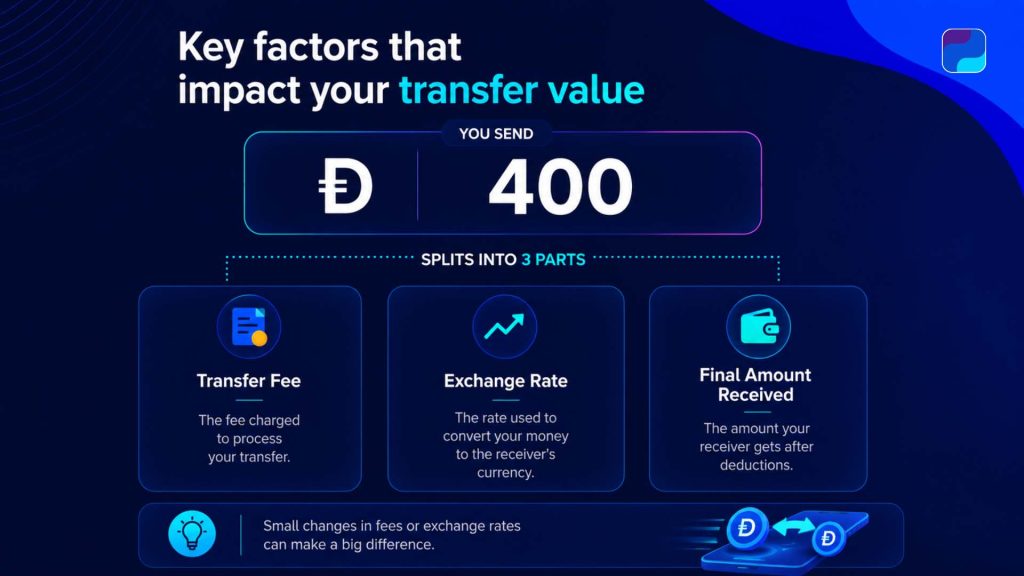
The real cost of sending money is not always obvious at first. It usually comes from three areas.
First, there are transfer fees. Some services charge a fixed fee per transaction. When the amount is small, that fixed fee becomes a larger percentage of what you are sending. It reduces the overall value received. [1]
Second, there is the exchange rate. This is often where money quietly slips away.
Even a slight difference in rate can change how much your family actually gets. Many users do not compare rates closely, especially when sending small amounts. [2]
Third, there can be hidden charges. These are not always clearly shown upfront. They may appear as service fees, processing charges, or margins included in the exchange rate. This is why the final received amount often matters more than the fee alone. [1]
Understanding these three factors helps you see why choosing the right remittance option is important, even for small transfers.
People choose to send smaller amounts for many practical reasons. One of the biggest reasons is budget control. It is easier to manage finances when money is sent in smaller, planned portions rather than large lump sums.
Smaller transfers also allow regular support for family members. Instead of waiting to send a bigger amount later, many prefer to send consistent support throughout the month. This helps cover ongoing expenses like groceries, utilities, or school needs.
Living and working in the UAE also comes with its own cost responsibilities. Rent, transport, and daily expenses require careful planning. Smaller transfers help avoid financial pressure while still fulfilling family commitments.
For many people, sending smaller amounts regularly is easier to keep up over time. It helps maintain balance without creating financial strain.
So what makes a good remittance option for small transfers?
The most important factor is low or no transfer fees. When sending under AED 500, even small fees can reduce the final value significantly. A good option should keep costs minimal. [3]
Fair exchange rates are equally important. The rate should be close to the real market rate so that your recipient gets the maximum possible value. Transparency here is key. [2]
Speed also matters. Instant or quick transfers ensure that money reaches when it is needed, especially in urgent situations. [4]
Finally, transparency is essential. You should know exactly what you are paying and what your recipient will receive before confirming the transfer. There should be no confusion or hidden deductions. [1]
Beyond choosing the right service, developing smart money habits can make a big difference over time.
Make use of an exchange fee calculator. With several free options available online, you can know how much money you will get on the other side after remittance.[5a]
Avoiding last-minute transfers is another useful habit. Urgent transfers often limit your options and may lead to higher costs. Planning ahead gives you more control. [6]
Beware of mark-up rates. Banks and money transfer services use the mid market rate when they trade between themselves but rarely give it to you. Look online for the mid market rate which is also known as the inter-bank rate which the rate banks use to transfer money between themselves.[5a]
Tracking your transfers regularly is also helpful. It allows you to see patterns in how much you are sending and how much value is actually received. This builds better awareness of your financial habits.

Platforms like Payit make this process simpler by showing you up‑to‑date exchange rates before you send. This helps you understand exactly what your recipient will receive before you send money.
Payit also supports instant transfers, which is useful for both planned and ad hoc needs. Whether it is a regular monthly support transfer or an unexpected requirement, speed and reliability make a difference.
One of the key benefits is transparency. You can clearly see rates and final amounts upfront, which helps you make informed decisions, especially when sending smaller amounts frequently. This removes uncertainty and helps you stay in control. [1]
With solutions like Payit, managing frequent small transfers becomes easier and more structured. It allows you to stay consistent without worrying about hidden costs affecting your budget.
There are also real-life situations where this approach becomes especially useful. For example, some people send weekly support for groceries or daily expenses. Others may send a small mid-month transfer for unexpected needs like medical bills or urgent household costs. In some cases, small amounts help family members manage ongoing commitments without waiting for a larger transfer at the end of the month.
These smaller, consistent actions often create more stability than irregular large transfers. They help both sender and receiver plan better.
Sending smaller amounts is not about sending less. It is about sending smarter. It allows you to stay consistent, support your family, and still maintain control over your own finances.
With the right approach and the right tools, small transfers can become a powerful way to manage money better. It is a simple shift in habit, but one that brings long-term financial clarity and confidence.