
Home » Cashless Payments Knowledge Hub » How Big Is the Remittance Market in the UAE? Statistics, Trends, and Insights for Expats
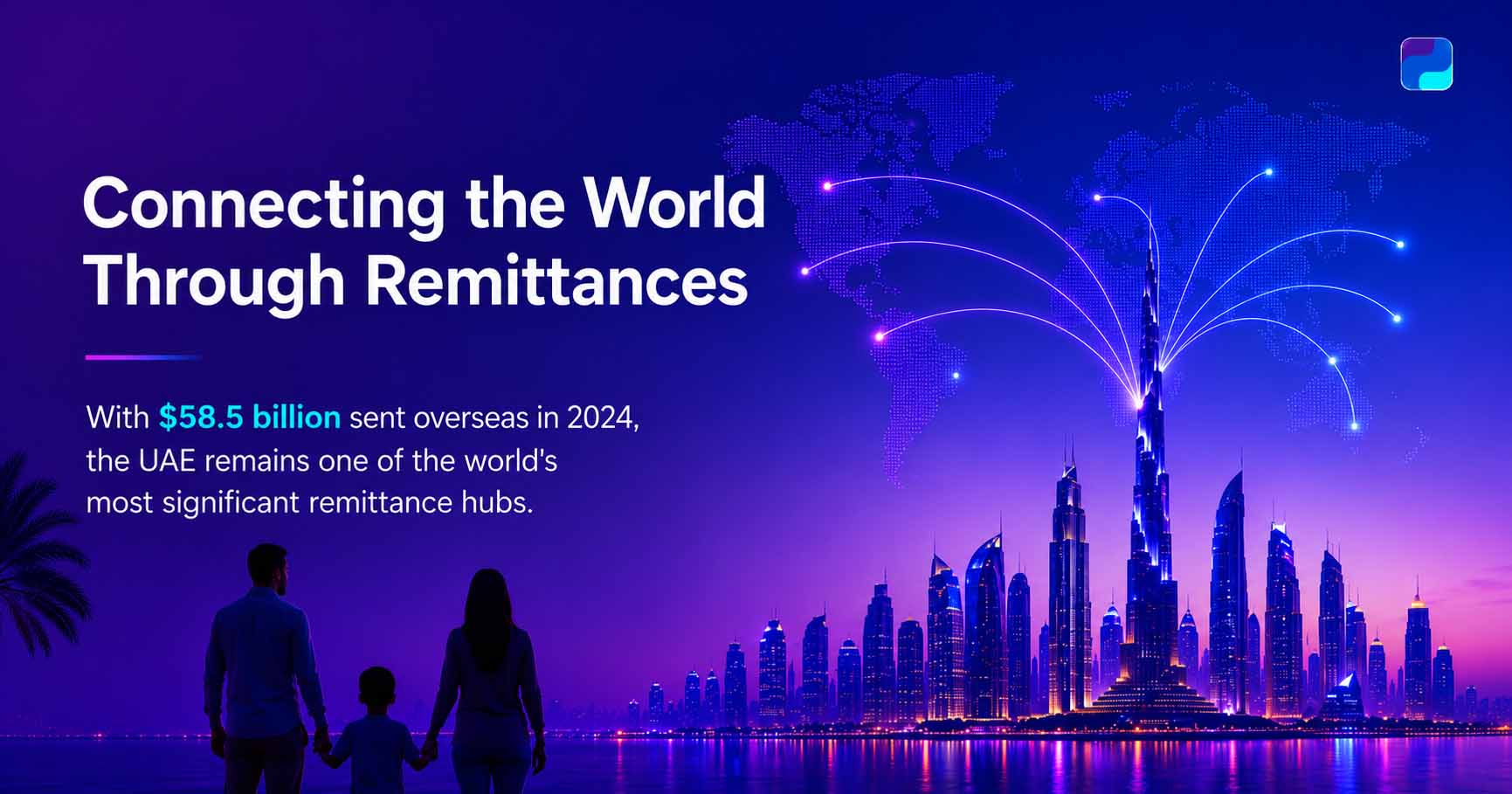
The UAE is one of the world’s largest remittance-sending countries, with tens of billions of dollars flowing overseas every year.
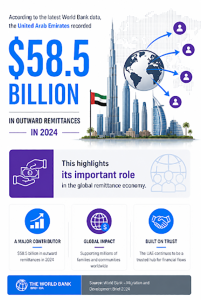
According to the latest World Bank data, the United Arab Emirates recorded approximately $58.5 billion in outward remittances in 2024, highlighting its important role in the global remittance economy.
For millions of expatriates and migrant workers, sending money home is a regular part of life. These transfers help families pay for education, healthcare, housing, food, and everyday expenses. They also support local economies in countries that rely heavily on remittance income.
Today, the UAE’s remittance market is evolving rapidly.
Traditional banks and exchange houses remain important, but digital wallets, mobile banking apps, and online money transfer platforms are changing how people move money across borders.
In this guide, you’ll learn:
Last Updated: June 2026
If you’re looking for a quick answer, here are the most important facts about the United Arab Emirates remittance market:
These factors have helped position the UAE as one of the most influential players in the global remittance economy.
The UAE is considered to be one of the world’s most important hubs for international money transfers. The country consistently ranks among the leading sources of outward remittance flows.
Metric | Verified Insight |
Global Position | Among the world’s largest remittance-sending countries |
Outward Remittances | Approximately $58.5 billion in 2024 (World Bank) |
Primary Users | Expatriates and migrant workers |
Main Recipient Regions | South Asia and Southeast Asia |
Popular Transfer Channels | Banks, exchange houses, digital wallets, mobile apps |
Key Growth Driver | Expansion of digital financial services |
While exact yearly totals can vary, the UAE’s role in the global remittance ecosystem remains significant.
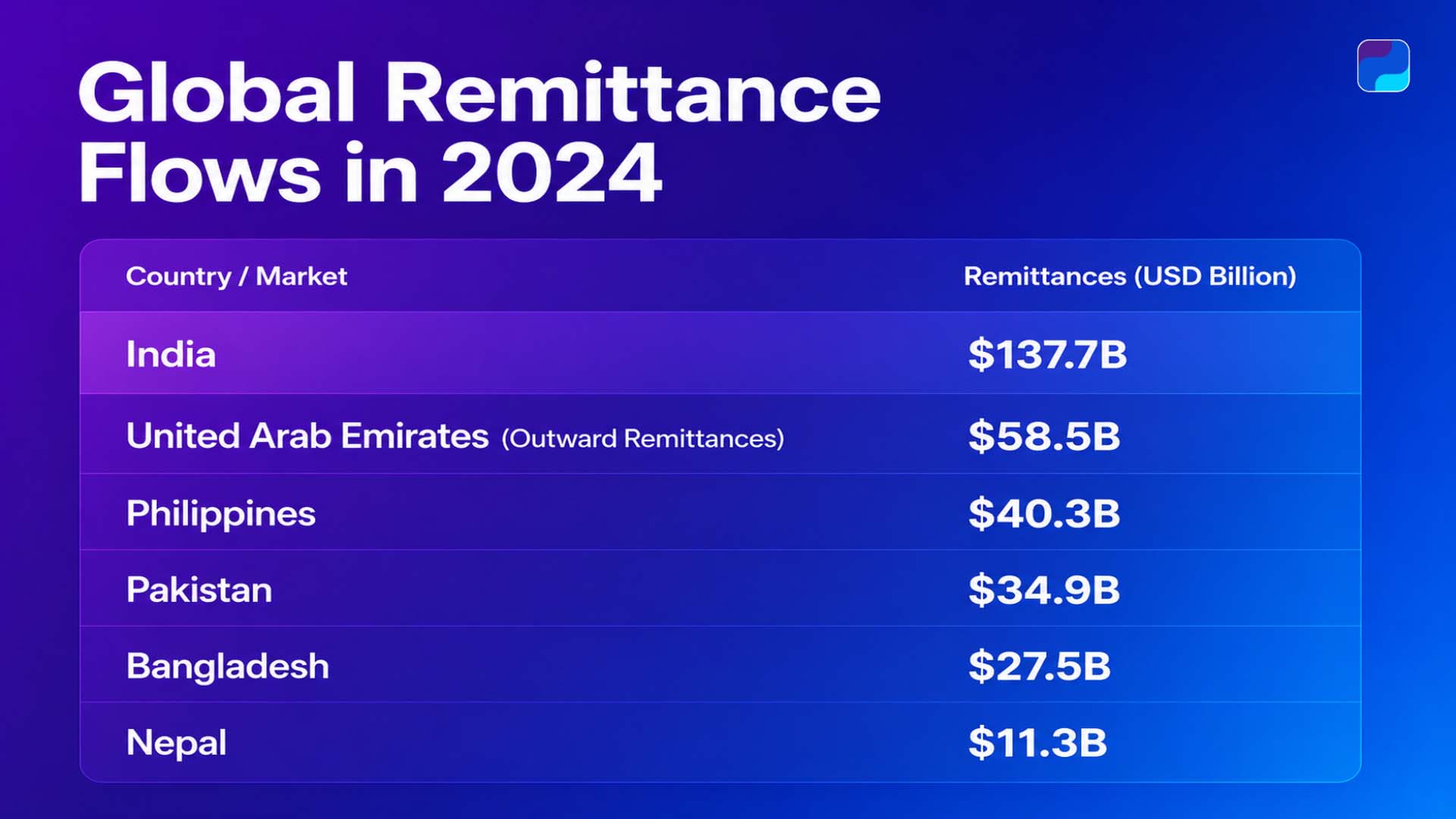
According to the latest World Bank remittance data, India remained the world’s largest remittance recipient in 2024, receiving approximately $137.7 billion from citizens living and working abroad. The Philippines received approximately $40.3 billion, followed by Pakistan at $34.9 billion , Bangladesh with $27.5 billion, and Nepal at $11.3 billion.
At the same time, the United Arab Emirates recorded approximately $58.5 billion in outward remittances, making it one of the world’s largest financial market.
Country | 2024 Remittances |
India | $137.7 Billion |
UAE (Outward Remittances) | $58.5 Billion |
Philippines | $40.3 Billion |
Pakistan | $34.9 Billion |
Bangladesh | $27.5 Billion |
Nepal | $11.3 Billion |
Several factors help explain why the UAE has become one of the world’s most important remittance markets.
The UAE is home to millions of foreign workers from countries such as:
Many expatriates move to the UAE for employment opportunities while maintaining strong financial ties with their families back home.
For these workers, sending money home is often a monthly necessity rather than an occasional transaction.
The UAE’s economy continues to attract workers from around the world.
Employment opportunities across industries such as construction, hospitality, healthcare, transportation, retail, technology, and finance help generate consistent demand for international money transfers.
The UAE offers one of the most developed financial systems in the region.
Residents can access:
This broad range of options makes it easier for people to send money quickly and securely.
Consumer behaviour is changing.
People increasingly prefer digital payment solutions that offer convenience, speed, and transparency.
This trend is helping accelerate the growth of digital remittances across the UAE.
When people think about remittances, they often focus on the transfer itself.
However, the real impact happens after the money arrives.
For many families, remittances provide a reliable source of income that supports essential needs and long-term goals.
Many transfers help cover:
For some families, remittance income plays a critical role in maintaining financial stability.
Education remains one of the most common uses of remittance income.
Money sent from the UAE often helps pay for:
These investments can create opportunities for future generations.
Healthcare costs can be difficult for many households to manage.
Remittances are frequently used for:
Many expatriates send money home to:
These investments often provide long-term financial security.
Some recipients use remittances to:
As a result, remittances can contribute not only to household well-being but also to broader economic development.
The UAE sends money to destinations all over the world.
However, a large share of these transfers flows to countries in South Asia and Southeast Asia, where many expatriate workers maintain close family and financial ties.
The countries most closely connected to UAE remittance flows include India, Pakistan, Bangladesh, Philippines, and Nepal.
These countries share strong migration and economic connections with the UAE, making them some of the most important destinations for money sent from the Emirates.
In the next section, we’ll take a closer look at each of these countries, examine their remittance inflows, and explore why the UAE remains such an important source of financial support for millions of families worldwide.
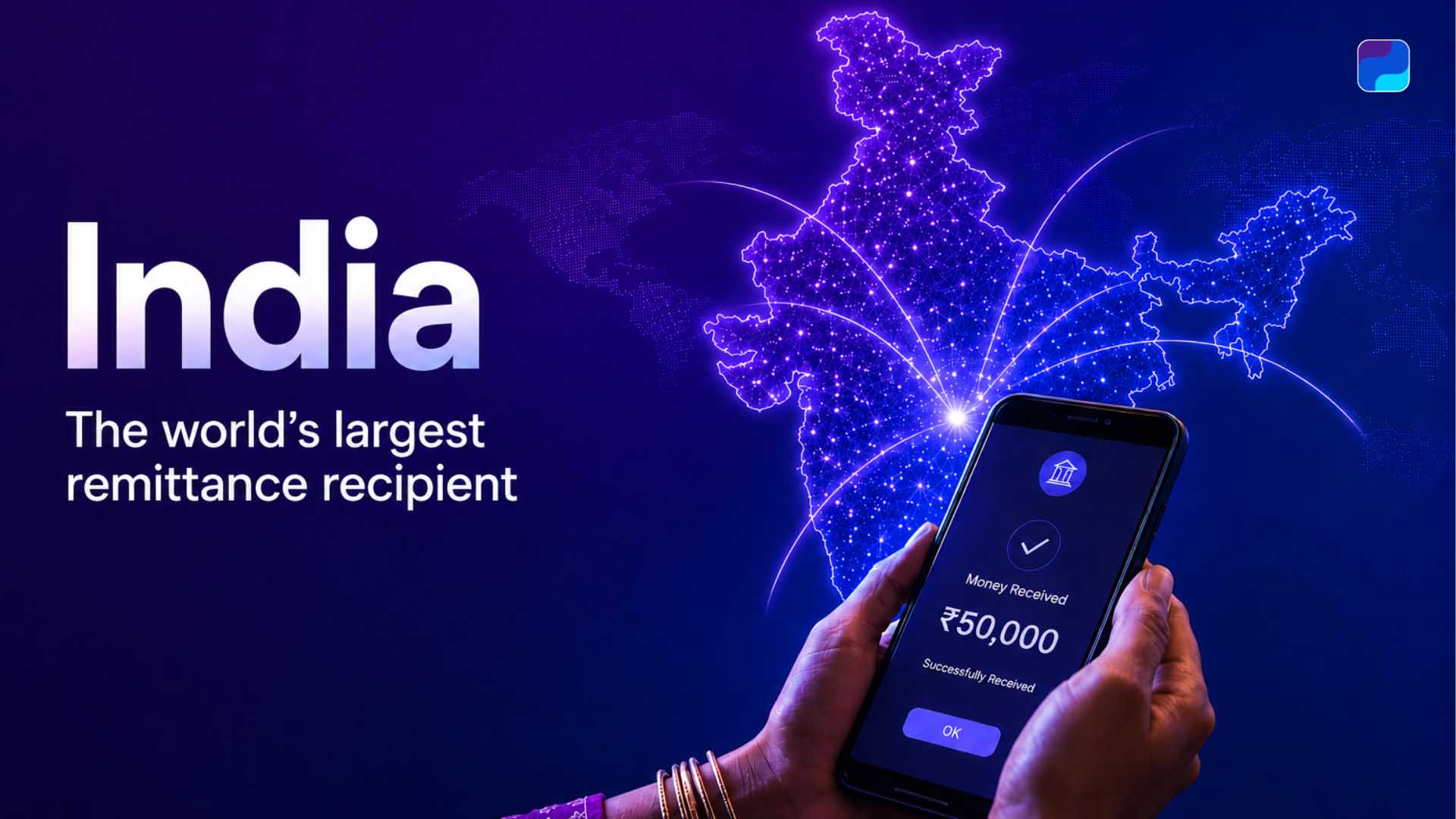
India is the largest remittance-receiving country in the world.
According to the World Bank’s Personal Remittances Received dataset for India, the country receives well over $137.7 billion annually from citizens living and working abroad.
The UAE plays a major role in this corridor because it is home to one of the largest Indian expatriate communities outside India.
Millions of Indian workers across sectors such as:
regularly send money home to support family members and invest in their future.
Money sent from the UAE often helps pay for:
Because of the strong migration and economic ties between both countries, the UAE–India corridor remains one of the most important remittance routes in the world.
Pakistan is another major recipient of remittance inflows from overseas workers.
According to World Bank data, Pakistan received approximately $34.9 billion in remittance inflows in 2024, underscoring the importance of overseas workers to the country’s economy.
The money sent home by expatriates contributes significantly to household income and national economic activity.
For more detailed and frequently updated statistics, the State Bank of Pakistan publishes official workers’ remittance reports.
Many Pakistani workers in the UAE are employed in:
For many households, remittance income helps cover:
At a broader level, remittances also help support foreign exchange reserves and economic stability.
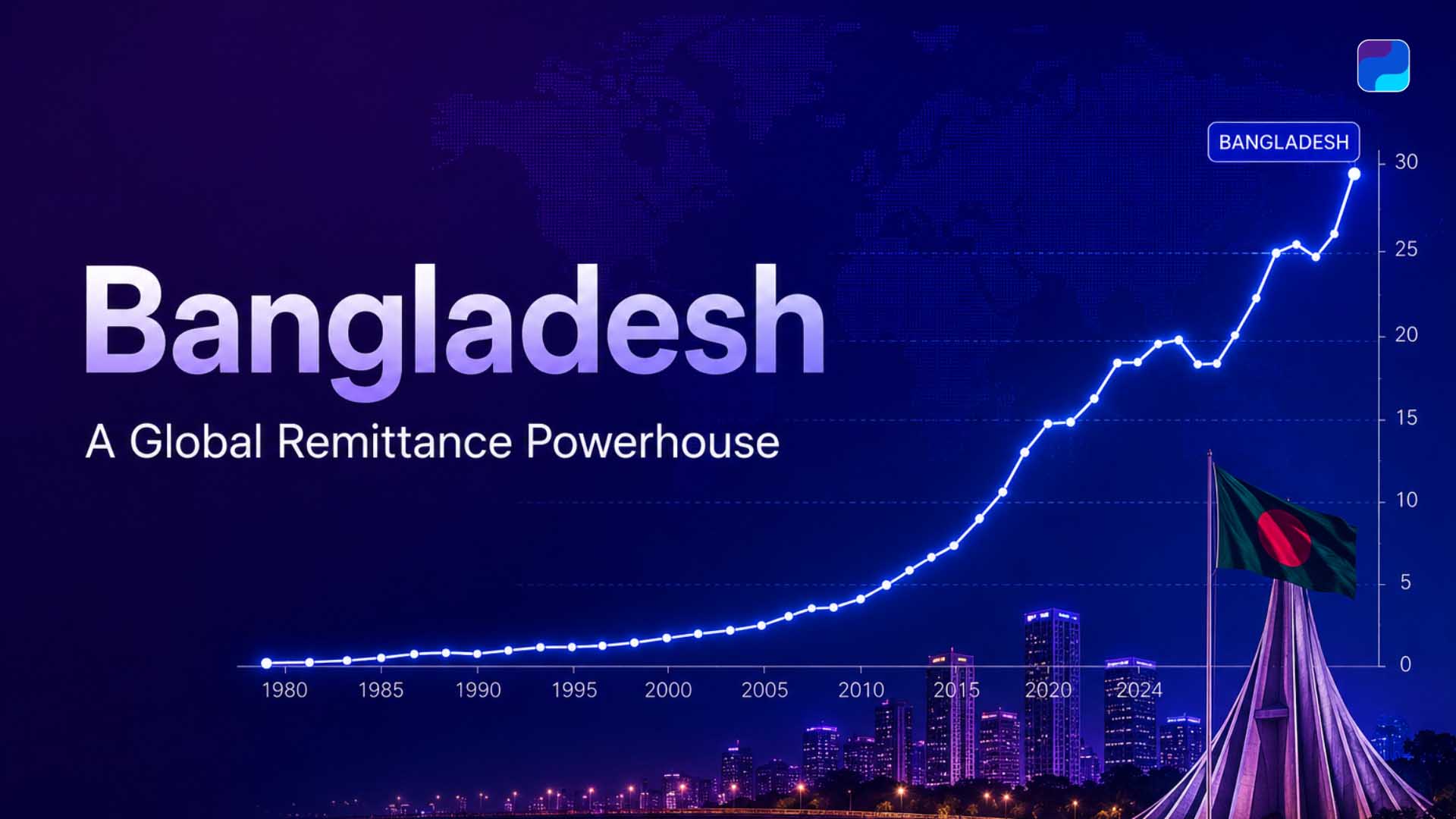
Bangladesh has become one of the world’s largest remittance recipients over the past two decades.
According to the World Bank’s Personal Remittances Received dataset, Bangladesh received approximately $27.5 billion in remittance inflows in 2024, making it one of the world’s largest remittance-receiving countries
Bangladesh Bank also publishes official remittance statistics through its wage earners’ remittance reports.
The UAE remains one of the most important destinations for Bangladeshi workers.
Many are employed in:
Money sent home often helps families:
Remittances also contribute to national development by strengthening foreign currency inflows and supporting economic growth.
The Philippines has one of the largest overseas workforces in the world.
As a result, remittances play a major role in the country’s economy.
World Bank data shows that the Philippines received approximately $40.3 billion in remittance inflows in 2024, making it one of the largest remittance-receiving countries in the world.
The Bangko Sentral ng Pilipinas (BSP) publishes official remittance statistics through its Overseas Filipinos’ Remittances reporting portal.
Many Overseas Filipino Workers (OFWs) living in the UAE work in:
Remittance income frequently supports:
For many Filipino families, money sent from abroad provides a vital source of financial stability.
Nepal has one of the highest levels of remittance dependence in the world.
According to the World Bank, Nepal received approximately $11.3 billion in remittance inflows in 2024, highlighting the significant role remittances play in supporting households and economic activity across the country.
Many Nepali workers are employed throughout the Gulf region, including the UAE.
Funds sent home often help pay for:
In many communities, remittances are a critical source of financial security and economic opportunity.
Although each country has its own economic conditions and migration patterns, one thing remains consistent – the United Arab Emirates play a crucial role in helping millions of families access financial support from loved ones working abroad.
These remittance flows create benefits that extend far beyond individual households. They also contribute to education, healthcare, entrepreneurship, housing development, and local economic activity across multiple regions of the world.
At the same time, the way people send money from the UAE is changing rapidly.
The size of these remittance corridors raises an important question:
The answer has evolved significantly over the last decade.
While banks and exchange houses remain important, digital payments are transforming the way people move money across borders.
To understand where the remittance market is heading, it is helpful to look at the broader UAE payments ecosystem.
The UAE has one of the most advanced payments markets in the Middle East.
Over the past decade, the country has invested heavily in digital transformation, financial technology, and payment innovation.
Today, consumers increasingly rely on:
This shift is helping reshape both domestic payments and international money transfers.
Consumers continue to embrace digital payment methods because of their convenience and accessibility.
Backed by McKinsey & Company, over nine out of ten consumers now use digital methods.
Additional insights from PWC Middle East highlight the growing importance of digital financial services across the region.
The UAE remittance market now offers more choices than ever before.
Historically, international transfers were dominated by:
Today, digital solutions have become increasingly popular.
Traditional transfer methods remain important because they offer:
However, they may also require:
Digital remittance solutions offer a different experience.
Users can often:
This convenience is one reason digital adoption continues to grow.
In the next section, we’ll compare the most common payment methods available in the UAE, explore how digital wallets are transforming international transfers, and answer some of the most frequently asked questions about sending money abroad.
With so many ways to send money internationally, choosing the right payment method can feel overwhelming.
The truth is that there is no single solution that works best for everyone.
The ideal option depends on several factors, including:
Understanding the strengths of each option can help you make better decisions and ensure that more money reaches your loved ones.
Payment Method | Speed | Convenience | Best For |
Bank Transfer | Medium | Medium | Large transfers and direct account deposits |
Exchange House | Medium to Fast | Medium | In-person support and cash pickup |
Money Transfer App | Fast | High | Frequent transfers and convenience |
Digital Wallet | Fast | Very High | Everyday financial management and remittances |
Cash Transfer Service | Fast | Medium | Recipients without bank accounts |
Each option serves a different need.
Let’s look at them more closely.
Bank transfers remain one of the most trusted methods for sending money internationally.
Advantages
Considerations
For larger or less frequent transfers, banks remain a popular choice.
Exchange houses continue to play a major role in the UAE remittance market.
Many expatriates prefer them because they offer:
Advantages
Considerations
For customers who value in-person support, exchange houses remain a reliable option.
Money transfer apps have transformed how people send money from the UAE.
Instead of visiting a branch, users can complete transfers directly from their smartphones.
Advantages
Many users now prefer mobile-first experiences because they save time and simplify the transfer process.
Digital wallets are becoming one of the fastest-growing payment solutions in the UAE.
Unlike traditional transfer methods, digital wallets often combine several financial services into a single platform.
Depending on the provider, users may be able to:
This convenience has helped drive the rapid adoption of digital wallets among expatriates and migrant workers.
The UAE’s remittance market is becoming increasingly digital.
What once required paperwork and branch visits can now often be completed in minutes using a smartphone.
Digital wallets are playing a major role in this transformation.
Consumers increasingly want financial services that are:
Digital wallets help meet these expectations by allowing users to manage multiple financial activities within a single application.
Users can often send money, pay bills, and manage transfers without visiting a physical location.
Many digital platforms display:
before a transfer is completed.
Mobile-first solutions make financial services available to a wider range of users.
Many transfers can be processed faster than traditional methods, depending on the destination country and payment network.
The remittance landscape continues to evolve.
Several trends are expected to shape the future of international money transfers.
According to a Visa Middle East report, nearly two-thirds of UAE residents now prefer sending money through digital apps rather than traditional channels.
Respondents cited ease of use (50%), along with speed, safety, and privacy (46%), as the main reasons for choosing digital transfer solutions.
The study also found that 95% of respondents send remittances at least once a year, highlighting how important international money transfers remain for expatriates and migrant workers.
These findings reflect a broader trend toward mobile-first financial services that make sending money faster, more convenient, and more accessible.
And this is likely to accelerate the growth of digital remittances.
Smartphones have become the primary gateway to financial services for many consumers in the Middle East including the United Arab Emirates.
As mobile usage increases, app-based transfers are expected to become even more common.
Financial institutions continue to invest in:
These improvements help create smoother customer experiences.
As banks, fintech companies, exchange houses, and digital wallet providers compete for customers, users may benefit from:
The following questions are among the most searched topics related to remittances and money transfers from the UAE.
The UAE is one of the world’s largest remittance-sending countries.
According to the World Bank’s latest remittance data, the UAE recorded approximately $58.5 billion in outward remittances in 2024, making it one of the world’s largest remittance-sending countries.
The country continues to rank among the leading global sources of international money transfers.
The UAE has one of the most advanced payments ecosystems in the Middle East.
Consumers increasingly use:
This digital transformation is helping reshape both domestic and international payments.
The most important remittance corridors connected to UAE workers include India, Pakistan, Bangladesh, the Philippines, and Nepal. According to World Bank data, these countries collectively received more than $250 billion in remittance inflows in 2024, underscoring the global importance of migrant workers and cross-border money transfers.
The cheapest option depends on:
Always compare the final amount your recipient will receive rather than focusing only on transfer fees.
Many digital transfer services offer faster delivery than traditional methods.
However, delivery speed depends on:
Some transfers may arrive within minutes, while others take several business days.
Digital wallets offered by regulated financial institutions generally include:
Users should always choose trusted and regulated providers.
Yes.
Many digital wallets, banking apps, and online transfer platforms allow users to initiate international transfers directly from their mobile devices.
This convenience is one of the main reasons digital remittances continue to grow.
Exchange rates play a major role in determining how much money your recipient receives.
Even a small difference in the exchange rate can significantly affect the final payout amount.
This is why it is important to compare both fees and exchange rates before completing a transfer.
You can send money internationally from the UAE through banking apps, digital wallets, and online money transfer platforms without visiting a branch.
The exact documents and details required to send funds overseas from the UAE depend on the transfer provider, destination country, transfer amount, and compliance requirements. In general, users need to complete identity verification and provide accurate beneficiary details before making an international transfer.
To avoid hidden costs in international money transfers, users should compare the final amount the recipient receives rather than looking only at the transfer fee. Exchange rates can also affect the final payout amount, so it is important to compare both fees and exchange rates before sending money.
To collect cash sent from abroad in the UAE, the recipient will generally need the transfer details and a valid government-issued ID.
Many digital transfer services, money transfer apps, and mobile wallets offer international money transfer options from the UAE. The best platform depends on the transfer amount, destination country, exchange rate, provider fees, delivery speed, and security features. Users should compare providers carefully and choose trusted and regulated services.
The UAE remains one of the most important remittance hubs in the world.
Every year, billions of dollars flow from the UAE to families, communities, and businesses across Asia, Africa, and other regions.
For many households, these transfers help pay for education, healthcare, housing, food, and long-term financial goals.
At the same time, the way people send money is changing.
Digital wallets, mobile banking applications, and online transfer platforms are making international payments faster, more convenient, and more transparent than ever before.
As technology continues to evolve, consumers will likely have even more options for sending money securely and efficiently.
For expatriates and migrant workers, understanding these options can help maximize the value of every transfer and ensure that more money reaches the people who matter most.
Reviewed by the Payit Content Team
Payit is a digital payments platform that helps users manage everyday payments, money transfers, and financial services through a secure mobile-first experience.
Data Accuracy Notice:
Remittance statistics, payment market data, and migration trends change over time. This article is reviewed periodically and updated using information from official sources such as the World Bank, IOM, central banks, and financial institutions.