
Home » Cashless Payments Knowledge Hub » Remittance Scams UAE Expats Should Know Before Sending Money Home
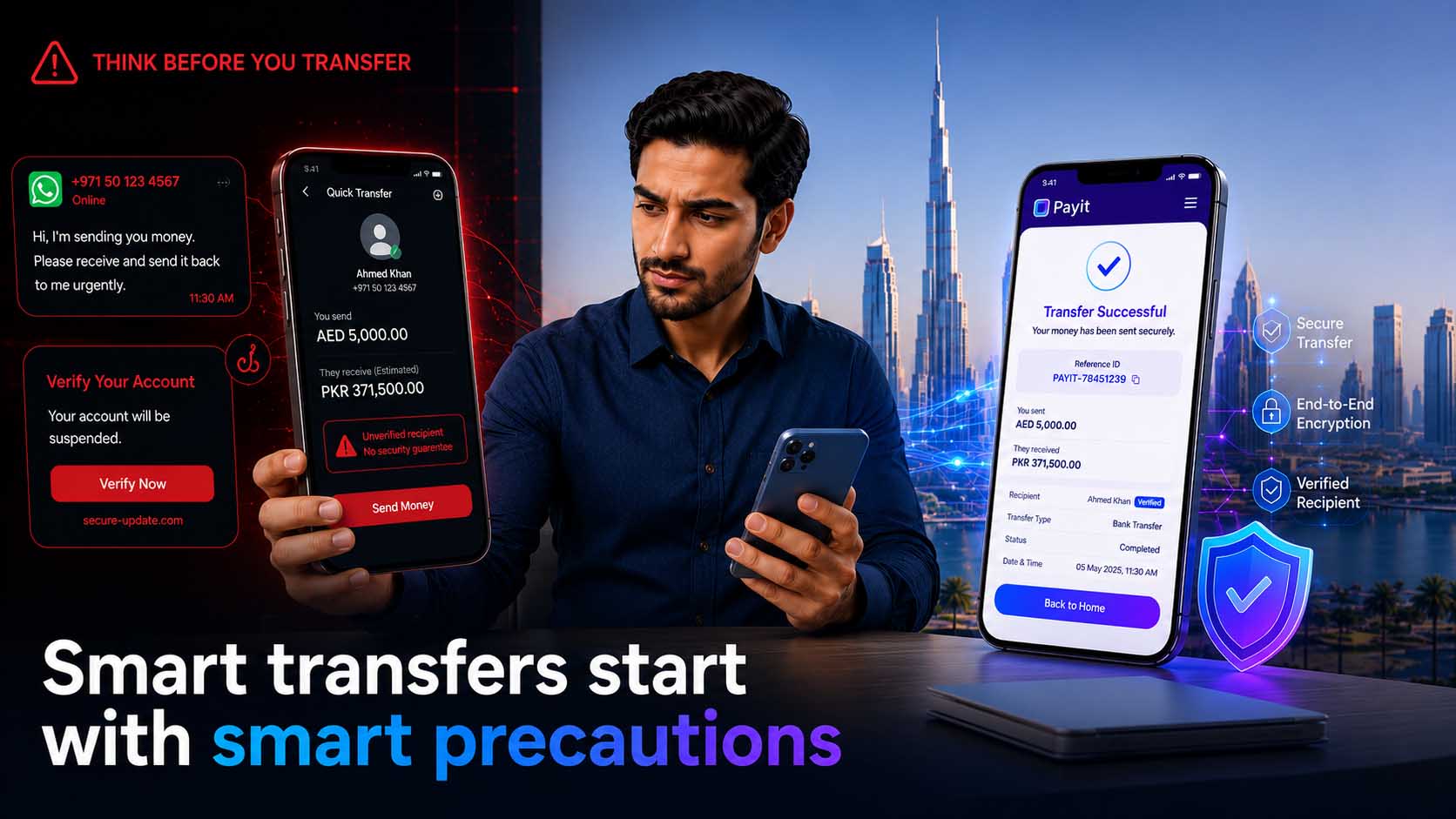
For many UAE expats, sending money home is a regular part of life. Every month, they transfer money to support their parents, pay school fees, cover medical expenses, or help with everyday household needs.
Today, sending money abroad is faster and easier than ever. With just a few taps on your phone, you can initiate an international money transfer conveniently through digital remittance services. But as digital transfers have become more convenient, scammers have also found new ways to target people sending money overseas. They use fake messages, phishing links, impersonation scams and fraudulent payment requests to trick people into sharing personal information or sending money to the wrong account.
Expats make up nearly 89% of the UAE’s population.[1] Millions of expats rely on international remittances to support their families back home. Understanding how these scams work can help you protect your hard-earned money.
Remittance users are not randomly chosen. Scammers specifically target their vulnerability. Most expats usually send money on fixed dates (salary cycles), react quickly during family emergencies, prefer faster mobile transactions over branch visits, trust apps or messages and may not double-check details twice.
This creates the perfect environment for scammers to manipulate you.
The key factor here is how the scammers act on your sense of urgency. When someone receives a message like “your family needs money immediately” or “your transfer is blocked,” the natural reaction is to act quickly, not to verify.
Once the transfer is completed, it is often difficult to recover funds, especially if the scam involves fake accounts and routes, which makes the effects irreversible if you are affected.
This starts with something as simple as a search result, a forwarded WhatsApp link, or a simple social media ad. You download an app that looks identical to a real service, with the same logo, colours, or a similar name. What you might miss is the fact that it is not licensed, not connected to any real banking system and is often designed to collect your login or card details.
Once installed these apps request permissions unrelated to payments (contacts, SMS, device access), which is a major red flag. Some versions even allow small transactions initially, build trust before disappearing with larger amounts.
These are messages designed to make you react immediately. Example:
“Your account is locked. Verify now, or funds will be frozen.”
“Suspicious activity detected. Click here to confirm.”
“Transfer delayed. Re-authentication required.”
The link takes you to a page that looks exactly like your bank or remittance app. Once you enter details, your login credentials are stolen, or payment instructions are redirected. This type of scam is widely documented in the UAE, where authorities repeatedly warn users not to log in through external links or unknown pages. [2]
This is one of the most common modern scams. You may complain on social media, search for support online, and then someone contacts you claiming to be “official support.”
They often use real logos, profile pictures and sound very professional. They come across as “your account needs verification”, OTP codes, card details and even remote access to your phone.
Regulated financial service providers generally do not ask customers to share OTPs, PINs or full banking passwords through calls, chats or messages.
Some websites or unofficial services advertise attractive exchange rates or low transfer fees to get your attention. However, the actual rates may be lower, hidden charges may apply, or the service itself may not be genuine.
Before confirming your transfer, always check the final exchange rate, review any fees, and make sure you’re using a licensed provider.
Real regulated providers in the UAE always display transparent exchange rates and fees before confirmation.
This one is often confusing because it appears to be a system error. You send money and receive but see these instead: “Transaction failed”, “Refund pending”, “Click here to reprocess”. You then re-enter details or send money again.
But the original transfer may already be successful, the refund page is fake or you are paying twice to scammers.
The safest rule: always check your transaction history inside the official app before acting on any message.
Here, the scammers pretend to be someone they might know. It can also be your close ones far from home. Often, a lot of expats fall for this scam as it causes a sense of panic. Scammers impersonate a family member on WhatsApp, claim there are urgent medical or travel issues, or pressure you to send money immediately.
This works because it bypasses logic and targets emotion.
The only safe response is to verify through a call or a second family contact; never rely only on chat messages for urgent transfers.
Scammers may claim that money is waiting for you, but ask you to pay a processing or verification fee first. Once you make the payment, they keep asking for more money while the promised funds never arrive.
Remember, legitimate financial institutions will never ask you to pay upfront to access funds or rewards.
Before sending money, pause for 30 seconds and ask yourself:
✓ Did I open the official app directly (not a link)?
✓ Is the provider licensed in the UAE?
✓ Is anyone asking for OTP, password, or PIN?
✓ Does the exchange rate look realistic?
✓ Look for HTTPS in the URL for a secure connection
✓ Have I verified the request through another channel?
✓ Is this request expected or completely new?
If even one answer feels off, stop and recheck.
If something goes wrong or feels suspicious,
There are several methods to report fraud in the UAE. The Dubai Police has an online eCrime portal at ecrimehub.gov.ae where you can file complaints 24/7. Alternatively, you can use the Dubai Police App, go to Smart Police Stations or dial 901 for general inquiries. The Ministry of Interior’s Cybercrime Platform, available through the MoI UAE app, enables you to lodge reports, share the details about cybercrimes and receive expert advice on how to deal with online threats. [3]
Not all risk comes from scams; sometimes it comes from unverified systems.
A trusted remittance provider should be regulated in the UAE financial system, show full fees and exchange rates upfront, use secure authentication (OTP-based systems), never ask for sensitive credentials outside the app, and have verified customer support channels.
Platforms like Payit that operate within the regulated UAE financial ecosystem are designed to comply with applicable regulatory and security requirements.
In the UAE, the most common scams include shopping fraud, identity theft, and investment scams. 56% of residents encounter scams monthly, primarily through WhatsApp, phone calls, SMS, and email. AI-powered scams are also rising, with half of respondents reporting they’ve faced one, though awareness of AI-generated content remains low. [4]
While scams outside the platform still exist, using a regulated digital wallet like Payit may help reduce the likelihood of interacting with unknown and unverified third-party platforms.
For UAE expats sending money home, a few seconds of verification can prevent serious financial loss. Use trusted platforms, avoid public WI-Fi, double-check details, check bank statements regularly, and you can help reduce your exposure to common remittance scams. [5]
Your money is your hard work; protect it by staying smart!
[1].https://en.wikipedia.org/wiki/Expatriates_in_the_United_Arab_Emirates
[2].https://www.dubaipolice.gov.ae/app/home/media/news/news-details?id=l2nuaxe9a63gtwfbseghxl1h
[3].https://chambers.com/articles/fraud-in-uae-how-to-identify-scams-and-protect-your-rights
[4].https://www.wam.ae/article/b6f93te-2024-state-scams-uae-survey-reveals-65-scam
[5].https://www.dubaipolice.gov.ae/app/home/media/news/news-details?id=joxf72ma0fgakxsrqdkldo4c