
Home » Cashless Payments Knowledge Hub » Why Some UAE Money Transfers Take Minutes While Others Take Days

It’s the end of the month. Your salary has just been credited, and like any expat living in the UAE, the first thing you do is send money to your loved ones back home. The transfer is confirmed, you message your family, and within minutes, they tell you the money has arrived.
A few weeks later, you make another transfer to the same receiver and for a similar amount, but this time it takes much longer to arrive.
The first question that naturally comes to your mind is ‘What went wrong?’
The answer usually depends on several factors beyond the app itself. Once you send money, it passes through different stages before reaching the recipient. Banking networks, currency conversion, compliance checks, the destination country’s payment infrastructure, and even public holidays can all influence how quickly the money arrives.
International money transfers from the UAE can be initiated through digital remittance apps, local exchange houses, or wire transfers.
Traditional transfers usually move through the SWIFT network, which is used to send payment instructions securely between banks worldwide. But SWIFT does not actually move the money. Instead, the funds are settled through correspondent banks, so a transfer might go through several banks before reaching the recipient. [1]
Each bank handles its own processing, settlement, and compliance checks, which slows down the process compared to digital remittance services.
Digital wallet transfers usually work differently. Many digital remittance platforms connect directly with local payment systems or financial partners in supported countries. [2] By reducing the number of intermediary institutions involved, these payment routes may enable faster transfers, although delivery times still depend on factors such as compliance requirements, the destination country, and the receiving institution.
The time it takes for an international money transfer to reach the recipient can vary. This depends entirely on a series of factors and on the methods you use to transfer money.
Depending on the service you choose, funds may be sent through bank account transfers, mobile wallets, cash pickup services, or local payment networks.
The fewer intermediary institutions involved, the fewer processing stages a transfer goes through, which is one of the reasons traditional banking methods take time while digital transfers arrive faster.
The rise of digital remittance platforms and wallet-to-wallet transfers has reduced processing time, with research showing that more than 50% of expatriates now use or prefer online services. [3]
Remittance corridors depend heavily on the destination country’s banking infrastructure.
The UAE boasts one of the largest outbound remittance corridors globally, primarily driven by an expat population exceeding 85%. The largest real remittance corridors by volume flow heavily into India, Pakistan, Egypt, and the Philippines. [4]
For example, India, one of the UAE’s largest remittance corridors, operates the Unified Payments Interface (UPI), a real-time payment system. The UAE has modernised these corridors by interlinking its digital payment infrastructure with global networks such as connecting India’s UPI, which can make many eligible transfers faster.
Some countries have invested in real-time payment infrastructure, while others continue to rely mainly on traditional banking networks. This can make money arrive at different times depending on the country’s banking infrastructure.
When you send money from one currency and the person receives it in another, the money transfer then requires foreign exchange conversion before the funds are delivered.
Currency conversion times can also vary depending on the currencies involved. Some currency pairs are traded more actively in global foreign exchange markets than others. Widely traded currency pairs are easier to exchange, while less frequently traded or more tightly regulated currencies may involve additional processing before the transfer is completed
Even after the money reaches your chosen destination, the process is not always complete.
The receiving bank carries out its own verification processes before crediting the amount to the account of the person receiving it. Internal processing timelines vary from bank to bank, so it may take longer for the recipient to receive the funds even after the transfer is complete.
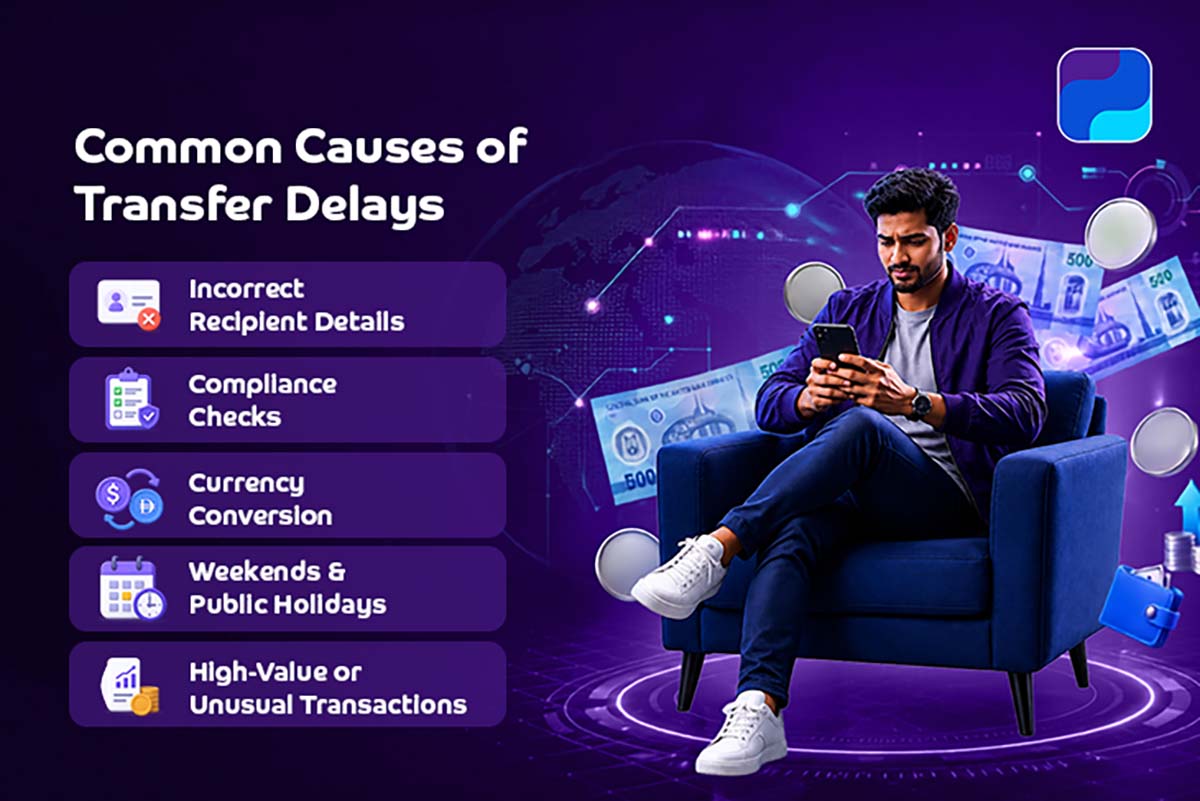
A delayed transfer doesn’t always mean there’s a problem. While some delays are beyond your control, others may be due to incorrect recipient details or additional verification requirements. Understanding these common reasons can help you avoid unnecessary delays and plan your transfers better.
For a more detailed explanation, read our guide on the common reasons online money transfers can be delayed.
Faster Transfers | Slower Transfers |
Correct recipient details | Incorrect recipient details |
Local payment networks | Multiple intermediary banks |
Same-currency transfers | Transfers requiring currency conversion |
Business days | Weekends and public holidays |
Routine compliance checks | Additional verification requirements |
There are a few practical steps you can take to reduce avoidable delays even though some factors might be out of your control:
✓ Double-check recipient details before confirming your transfer.
✓ Send money before banking cut-off times where applicable. For example, The UAE observes Saturday and Sunday as the weekend (and traditional Western banks are closed on Sundays), sending money after banking cut-off times on a Friday or during the weekend may mean that traditional bank processing does not begin until the next business day. [5]
✓ Keep public holidays and weekends in mind, both in the UAE and the destination country.
✓ Complete any required identity verification (KYC) in advance.
✓ Choose a trusted digital remittance service that provides transparent delivery estimates and tracking.
Speed is important when sending money internationally, but so is knowing your money will reach the right person securely.
A reliable money transfer service should offer:
Digital remittance platforms like Payit are designed to make international transfers simple, secure, and transparent. While many transfers are completed quickly, delivery times may still vary depending on a series of factors. Understanding them helps you know when your money may arrive, but also how it’s being processed along the way.
When you’re sending money to someone you care about, every transfer is more than just money. It could be covering important expenses, supporting your family, or a way to simply stay connected.
Behind every transfer are banking networks, security checks, currency conversions and other processes that play a role in moving your money safely across borders.
Understanding how international transfers work can help you avoid common delays and plan with confidence and choosing a trusted remittance service makes all the difference. It keeps the process secure, transparent and can make sending money home a smoother experience.
Transfer times depend on factors such as the transfer method, recipient details, compliance checks, currency conversion, and the destination country’s banking system.
Yes. If a transfer requires currency conversion, it may involve an additional processing step before the funds are delivered.
Yes. If banks are closed in the UAE or the destination country, your transfer may be processed on the next working day.
Banks and financial institutions carry out security and regulatory checks to help protect customers and comply with legal requirements. These checks may occasionally add processing time.
Double-check the recipient’s details, complete any required verification in advance, and choose a trusted remittance service that provides transparent delivery estimates.
[1].https://razorpay.com/learn/what-is-swift/
[2]. https://www.elibrary.imf.org/view/journals/063/2024/002/article-A001-en.xml [3].https://www.researchandmarkets.com/reports/6212224/uae-cross-border-remittances-market?srsltid=AfmBOopGMl8eF8j1ys7InFVHxJLBK7WGHOeI2fWdepHMeG3o4eXtvksd
[4].https://paymentscmi.com/insights/united-arab-emirates-remittances-market-data-overview/
[5].https://razorpay.com/blog/cut-off-time-for-international-payments-guide/